
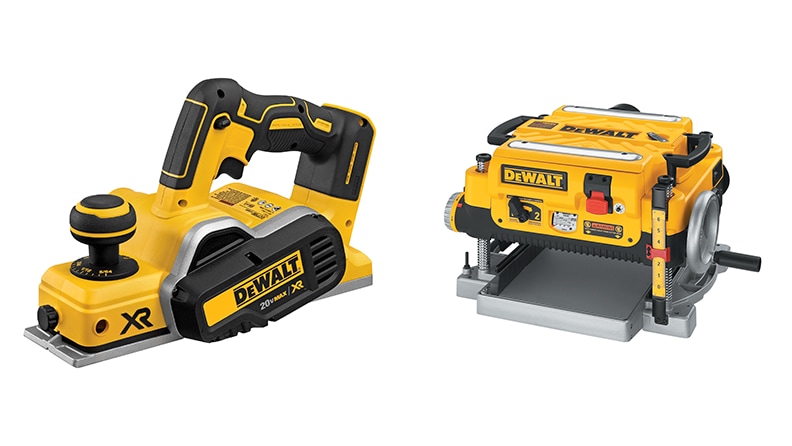
What is a Wood Planer?
A planer is a woodworking tool designed for a very specific function: trimming boards to a consistent thickness. For this reason, you may occasionally see this tool referred to as a thickness planer. Wood planers are primarily used for cutting raw lumber to size; however, they can also be used to trim finished boards for certain types of projects and for removing glue or finish coatings from the surface layer of existing boards. There are three main types of electric planers available: benchtop planers, handheld planers and stationary planers. You can also find non-powered handheld planers very similar to the ones woodworkers used in the days before electricity.
Types of Planers
Here’s an overview of the most popular types of planers used for common woodworking projects.
Stationary Planers


A stationary planer, or a fixed planer, is the largest type of electric planer. It’s the tool most often used for cutting large pieces of raw lumber to the appropriate size. These planers offer more horsepower than other types, which means they work more quickly and accurately, especially for high-volume applications. If you’re planning a very large project, such as building a deck, you may be able to save some money by purchasing rough lumber — rather than precut lumber — and cutting it into boards yourself with a rented stationary planer.
Benchtop Planers

A benchtop planer can be thought of as a smaller version of a stationary planer designed to sit on top of a work bench or other similar work surface. This type of tool is perfect for garage workshops or places where space is an issue. Benchtop planers come in a variety sizes. Some heavy-duty models offer a lot of horsepower, while smaller ones may offer less.
Electric Handheld Planers

A handheld electric planer is power tool that’s comparable in size to a circular saw. These machines are intended for smaller woodworking jobs and finishing jobs that involve quickly trimming or smoothing out a small amount of wood. Although heavy-duty options are available, handheld electric planers don’t offer the same power or adjustment options as benchtop or stationary planers. Also, because they lack a guide, it would be difficult and time-consuming to attempt to use a handheld model to process large amounts of lumber into uniform pieces.
Traditional Hand Planers

Before electric planers were invented, craftsmen relied upon hand planers for wood projects. A hand planer is essentially a small metal bar with an angled metal blade and a handle. To shave off wood from a piece of lumber, the user simply scrapes the planer across the wood surface. Although using a hand planer is much slower than a powered tool, it is preferable for jobs where precision is needed, such as furniture making or trimming moulding.
For more help with tools, see Woodworking 101: A Beginner's Guide to Woodworking.